Top 10 CRM Software Systems for Small Business

Ok.. I created a list for Mid-Market businesses. What about small and microsize businesses? Before I go and my two cents on this subject let me explain what a small/micro size business is to me. A small business is 5 to 20 employees and a micro is under 5. A friend of mine Donna Amos has created a term called solopreneur for those who work a one man/woman band.

  1. SugarCRM
    For small businesses this is truly a great tool with a low cost.

Top 10 CRM Systems for Mid-Market

Before you go and bash my list this my opinion based on 15 years experience and working directly with hundreds of clients and evaluating tons of packages.

  1. Saleslogix
  2. Salesforce.com
  3. NetSuite
  4. SugarCRM
  5. SplendidCRM
  6. mySAP
  7. MS Dynamics CRM
  8. SageCRM
  9. ZohoCRM
  10. vTiger

Just because I rated it #1 doesn’t mean its a fit for your business. Like accounting packages they all have their pros and cons. For example, if you run a retail store or car dealership, Saleslogix is not the best option for you. It doesn’t handle B2C type businesses very well. What you need to do in just about every case is talk to a consultant (like me!) and figure out the the best CRM option for your business.

Lead vs Prospect

What is the difference? So many people get this wrong that it prompted to blog about it.

A lead and a prospect are too completely different elements. One could argue that a suspect and a lead or similar. I would tend to agree with that argument.

My simple definition of a Lead: A potential consumer who you are not sure is qualified to purchase your goods or services.

My simple definition of a prospect: A consumer who has is qualified to purchase your goods or services, but has yet to make a purchase.

This has nothing to do with time as some salespeople often think. If a person is not making a purchase today doesn’t mean they are not a qualified prospect. Let’s look a scenario where people often make mistakes.
Company a sells special widgets. Salesperson calls on this lead and finds out the lead just bought a special widget from a competitor and not in a position to purchase again for another 24 months. The salesperson then records this lead as “unqualified” in their CRM database. WRONG!!!!!!!! This bites so many people in the butt. This is a HIGHLY qualified prospect. Just because they didn’t buy from you doesn’t disqualify them. In fact knowing they are with a competitor makes it easier to market to them. You should already know the strengths and weaknesses of your competitors.

Now what if you sold cars? Does this mean everyone who drives a car, which is just about everyone qualified? Not always. If you sold Class A luxury vehicles and your lead’s age is 45+ and household income of under $30K/year. Chances are they can not afford to buy that new BMW 750i. Even more so, you should not sell it to them. Now on the flipside… if a person who has a household income of $300K/year or more and you sell cars $9995 and under. They are not qualified and it would make no sense to try and make them a customer.

Now… I can hear the comments brewing about the last paragraph. What if? What if? There is always a trump card. If a person walks in and says I want that car here’s the money. You sell it to them and take the money. However, we’re talking about taking someone through the sales process not just a closed sale.

What should you do with all your unqualified leads???? Most people just mark them for dead. That’s one sad and twisted way of looking at it. First thing, Treat everyone as you would your best customer. Second, turn unqualified leads into powerful community influences/referral partners. That person who makes $300K/yr might have many friends or employees in need of cars under $10K.

So I am hoping everyone reading this article (all 10 of you…lol) will help me in getting rid of the term unqualified lead and clear up the confusion between a lead and a prospect.

How Reset A Password in SugarCRM 6.x

After a few hours of saying “I can’t believe this is not here”.  I realized that a very elementry feature is missing from the SugarCRM administrator tool.

The ability to manually set a user’s password.  Not sure if this is an oversight or just a bad design moved, but none the less SugarCRM 6.1 does lack this ability.

To reset or set a password in SugarCRM you will need access to the mySQL server database.    The easiest approach in my opinion is to use the mySQL Workbench.   You can use phpmyAdmin or simply a ssh connection to the server.

Once connected to the database you will need run the following sql statement  replacing _newpassword & _username_ I have below.

 
update users set user_hash = md5('_newpassword_') where user_name = '_username_';
Hope this helps someone save some time.

Getting Started with CRM

What is CRM?

CRM stands for Customer Relationship Management. In past years others have referred to it as SFA (Sales Force Automation), however SFA is only one element of the total picture. CRM includes the areas of Marketing, Sales, and Customer Service within your company. It provides a 360 degree view of your customers relationship with your company.

Why does CRM concern me?

Great question and I get asked this many times. First, let’s compare this to an accounting system. Every business by now understands the full benefits of an accounting system and important role it plays in telling you the present and past tense of your business in order to make decisions and spot trends. However, what about the future tense of your business? CRM provides you with the outlook of the future, so you can change the outcome of the present.

CRM also provides you with a tool to help you retain key customers. Ask yourself these questions; when was the last time your sales team or yourself spoke with your top 10 customers? Do you have documented, from each employee, the history of phone calls, emails, letters and meetings every with each client? Do you have an instant view of your sales pipeline from all your sales rep? Do you know how many new leads/prospects you received this quarter and how many are now sales? Do you know how many deals you lost by each competitor and why? These are just a few questions that CRM can answer.

About the Author of this article.

Before I continue let me introduce myself. My name is Levar Berry, President/CEO of eDriven Solutions. eDriven solutions is a CRM consulting firm located in Cincinnati, OH. I have been in the consulting world for 11 years and have helped 2-man shops up to large blue-chip companies create successful CRM systems.

The advice I am giving you in this article is a small portion of what CRM is all about. I would challenge you to begin learning more on your own or contacting a consultant to help you along the way.

How to prepare for a system?

Establishing a working CRM system first starts with a level of discipline and behavior changes within your company. Unlike other software packages, it requires more than just installing and configuring a software package.

First and foremost you need to document how your business does business. This is usually accomplished by creating a workflow chart in Microsoft Visio. Once this is created a consultant/VAR can help you identify pitfalls that are fixed with a CRM system. The end result is new and improved workflow document used to select a software package.

How to choose a VAR.

A VAR is a reseller of CRM of products and services. Usually VARs carry more than one line of products, since it is not one package fits all. When choosing a VAR you want to look for a VAR that has experience in creating cost reducing profit producing systems. Often times companies choose based on technical ability, although it is great asset to have, it leaves the customer to figure out how the system to look. In the past I have this as the #1 reason systems fails. You want a partner not just a worker-bee.You want someone who knows how to get the full value out of system and speaks about revenue and profit versus operating systems and programming jargon.

How to choose a software package.

Choosing a software package can be tricky. All of the packages have their own pros and cons. My advice would be first choose a VAR and let them assist you in choosing the right package. They will bring their experience to table and help you understand the differences.

More expensive does not always mean better. Cheaper packages are geared towards a different group of people and can often times get the job done for small businesses. It all depends on what you are selling and how you sell it.

How to rollout a system.

Installing the software is the easy part. The more important part of the rollout is to have an effective training program. To be most effective, your training program should be spread over time so the user does not have to swallow the entire system at once. Having predefined homework assignments have proven to delivery great results.

Classroom training is 10 times more effective than over the internet training, and class sizes under 15 people helps ensure everyone gets their questions answered. The max time on training should not exceed 5 hours. I have also found that it is best to not exceed more than 90 minutes without taking a break.

How to monitor a system.

The key to any successful system begins here. Monitoring the system ensures that you are getting the result you attended to get in the start of your mission. The #1 and most effective way to monitor the system is to have automated reports generated on a regular schedule. This is usually accomplished by third-party software. In my past 11 years, I have found companies that choose not to automate their reports, usually have a dead system or end up with just a big expensive rolodex.

In the reporting you must hold your end users accountable for the information that put into the system. For salespeople this could mean having them update their sales activity in the system by Monday at noon for the previous week and have reports print on automatically and emailed to their manager at 1pm. In addition, I have seen how reporting can increase sales due to salesperson competition. Each week a salesperson can compare themselves to the other salespeople and most are encouraged to reach the #1 spot.

Summary

Again is this a very brief tutorial of how to get started with CRM. I would encourage you to seek more information or contact a CRM consulting firm. The most important thing to remember is that CRM done correctly will help increase the profitability of your business. It will give valuable information to help you make key decisions. If the future of your company is important to you, then you need to explore the use of a CRM system in your company.

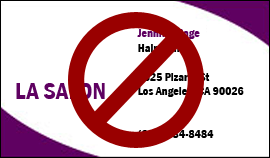
Business Cards Suck

Business Cards Suck!

I was cleaning my desk and then it occurred to me.   Business Cards SUCK!     I mean what’s the point anymore?  I have several business cards from the same person with a different look same info.     What does that DO???     I threw them all away.

Back pre-1995 when most people still had roledex on their desks, it was sort of important.   You give someone a business card so they can stick in their stacks of other cards.   It was the only “database” many people had.  Now,  who has a roledex?    Everything is stored in Outlook, Excel or hopefully…. a CRM database.   Its all gone digital.

Now am I saying you should throw away all your business cards you have now?  Of course not…… I am saying BURN THEM.   They don’t do anything for you that your website, linkedin or other digital media doesn’t do for you.     I was a networking meeting once, and a person once said they spent 6-months developing a new business card.  OMG!  Are you serious???    6-months on something that is out-dated and serves hardly any purpose.

So….    what should you do??  I mean you have to give people you meet offline something right?    Well…. it occured me that  we should begin giving out EXACTLY what we want back.  LEADS!.        We should turn our business cards into  LEAD cards.

What the heck is a Lead Card?   Its a term I just created!    Yes… credit me with the name ;)       A lead card is the same size as a business card, BUT it contains an ACTION statement, Discount Code, FREE offer…  something to get the person you hand the card to to make a move towards being a prospect for your business.    This gives your cards VALUE.   People will not throw away something that has VALUE to them.

For example… if you own a car wash.   Your LEAD CARD should contain directions to your wash, hours and an offer for a discounted wash.  This will get the person to do exactly what you want them to do.  VISIT your wash.    What about if you sell insurance?   One might think a good offer is  “Call me for a  FREE quote”.  Well,  the truth there is….  Everyone knows you offer free quotes.   Your offer needs to be a more unique and more meaningful to your prospects. Like  “Watch this New Video Report on Insurance Scams”  or “eBook: Are you under insured?”.  Something that gets the person to THINK and be curious and take action.

We all do this… including myself.   We can so caught up in explaining who we are and what we do.. instead of helping the client with the problem they are trying to solve.    I swear if I see one of my business card that says  “Serving the Area for over 20 years”.   WHO CARES!??  Honestly, sometimes when I read it, that makes wonder if you still “got it”.     I don’t like to call anyone out,  but Accountants are the worse.   99% of the cards I’ve seen are nothing more than a resume or VERY boring.  “John Smith,  Smith Accounting….  555-444-1212” (Blue-only letters)   Yawn!.    That doesn’t not make me want to call you or even be near you.   A lead card  could be as follows: “Bookkeeping is boring, but we love it!  Try us out for 2 weeks and see if we can’t ease your boredom”.   Something along those lines that ADDRESSES the PAIN your client is in.    Again,  we don’t care that you’ve been in business for 40 years.  Some of your clients are not even that old.

I think I am onto something here.  Be on the lookout for more around this topic.   I welcome your comments.

Creating profits with CRM

I’ll begin this first entry with a subject that is near in dear to me CRM. This blog will give you a quick real life approach to creating profits with CRM.

Unless you didn’t make past 5th grade you’ll know profits equal the amount of money you keep. Therefore there are two items that help create profits with CRM; cutting cost and increasing revenue.

Let’s look at cutting cost with CRM. I’ve been a CRM consultant since 1997, and I must say this is one powerful way of getting ROI out of your CRM application.

  • Reduce Paper Trails: Use CRM to store the information needed and rely less on paper based systems. Yes, even in today’s high tech world, I find a HUGE number of people still printing out paper. Just because you use Excel or Word doesn’t make it any better. I’ve seen cost reductions of 3%-7% to fulfill orders placed by your customers.
  • Communication Hub: Do you know much your internal communications are really costing you? Cell phones, long distance charges mount up fast. Using CRM as the center of inter-office communication reduces the need for these expensive alternatives. In addition, it creates more inter-office harmony and LESS DRAMA.
  • Reduce Mistakes: LOL… this never happens does it? Mistakes generally happen when there is a mis-communication between your ordering/accounting department and your sales department. With CRM everyone is on the same page in an orderly fashion. Emails back and forth often get misunderstood or lost in a shuffle.

There many ways in which CRM can help reduce cost. Those are just a few off the top of my little head. Now on the flip-side is the all important creating REVENUE!! (Yeah Baby).

  • Lead Management: Sound cliche? Well you wouldn’t believe the number of times I’ve worked with a group and marketing and sales don’t even speak let alone share the same data. Tracking leads from both ends insures everyone is on followed up. Often times I’ve marketing spend $15K+ on a tradeshow, get millions of names, store them in excel and call it a success. Excuse my language here (WTF!). OR! I’ve heard several times a salesperson say “I never follow up on those crap leads marketing gives me”. Leads=$$$
  • Pipeline Management: So are you top heavy or bottom heavy? Either one is bad news. LOL you don’t want to “back up your system”. CRM can tell you went you are about to get into a unwanted situation of having a lot of deals that won’t close or a lot of leads and nothing else. Moving these people through your sales process does one thing INCREASE SALES. As sure as prune juice, it will help keep you regular.
  • Team: This is by far the best value. No, one rockstar salesperson can match the power of team. Marketing to Inside Sales to Outside sales, all working together to generate revenue. This can only happen if they all use the same CRM to build customer relationships.

Those are just a few tips to put you to sleep for the evening. Check out my Audio CD coming out soon. It will be available at www.edrivenip.com titled The Silent Sales Army:CRM 4 Sales Managers. Later I will have a follow up CD called  The Silent Sales Solider:CRM 4 Sales Professionals.